The Core Unit
Three decision domains that together encompass everything required to deliver value. Authority and accountability are co-located — vested in the same unit, exercised by the same people.
Driver
The Driver owns the definition of success. Sets priorities, establishes acceptance criteria, and makes trade-offs when constraints force choices. Determines whether delivered work achieves its purpose.
Maker
The Maker owns how the solution is constructed. Determines architectural choices, technical approach, and sequencing. Designs and implements — full authority over the craft of building.
Guardian
The Guardian owns the decision to release. Assesses quality, security, compliance, and operational preparedness. Exercises judgment about whether the organization should ship — not a gatekeeper, but an owner.
The Problem
Organizations invest in frameworks, hire talented people, and refine their ceremonies — yet the same friction persists. The problem is not effort or intention. It is how authority, ownership, and flow are distributed across the system.
01
At enterprise scale, coordination cost can exceed execution cost entirely. The ratio may invert to forty-sixty or worse. Initiatives spend more time in alignment and waiting than in actual building.
02
Many parties can delay progress but none can unilaterally enable it. Decisions stall because authority is distributed across roles that each own only a piece of the outcome.
03
Implementation speed has accelerated dramatically. Organizational speed has not. The constraint has moved from building to everything surrounding building — decisions, governance, coordination.
Featured
Book 1 — 2025 • Legacy Books
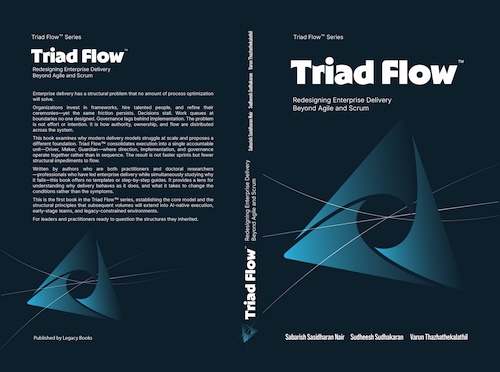
The first book in the series establishes the core model: the Execution Triad of Driver, Maker, and Guardian, flow-based progression, minimal ceremony, and integrated governance. Written by practitioners who are also doctoral researchers — professionals who have led enterprise delivery while studying why it fails.
Peer-reviewed research submitted to the International Journal of Multidisciplinary Allied Research Review (IJMARR). Presents the structural analysis of five enterprise delivery constraints and the consolidated ownership model. Pre-print available for download.
Structural Principles
Triad Flow™ does not prescribe ceremonies, artifacts, or scaling blueprints. It prescribes a different arrangement of authority and accountability — a structural pattern for organizing delivery.
_
Complete decision authority resides at the point of execution. The people responsible for delivering value possess the authority to make the decisions delivery requires.
_
Work progresses at its natural pace. Flow cycles are defined by readiness, not duration. Work ships when it is ready, not when a calendar dictates.
_
Risk assessment is embedded in execution, not positioned as an external checkpoint. The Guardian is present during execution, not after it. Governance enables rather than controls.
What Leaders Are Saying
Perspectives from technology executives, delivery leaders, and transformation practitioners who have confronted the structural realities Triad Flow™ addresses.
We spent years adding processes to fix delivery problems that were structural in nature. The Driver-Maker-Guardian model gave us language for what we had been doing wrong — and a clear alternative. Coordination overhead dropped measurably within the first quarter.
Every scaling framework we tried added complexity. Triad Flow™ did the opposite. Consolidating ownership into three decision domains eliminated the approval chains that were silently killing our velocity. Our teams now ship when ready, not when the calendar says.
The Guardian role transformed how we think about governance. Instead of a review board that slows everything down, we have embedded risk ownership at the point of execution. Governance went from bottleneck to enabler.
I have led SAP transformations across three continents. The structural diagnosis in this book is the most accurate account I have read of why large programs stall. Triad Flow™ gives program leaders a fundamentally different lens for organizing delivery.
Adopted By
Engineering organizations across financial services, healthcare, manufacturing, retail, and technology are applying Triad Flow™ principles to restructure delivery.
In the Press
How the industry is responding to the structural critique of enterprise delivery and the Triad Flow™ alternative.
January 2025
A new framework challenges the assumption that better ceremonies lead to better delivery. The authors argue that ownership structure, not methodology, determines execution speed.
Read article →February 2025
As AI coding tools accelerate implementation, the bottleneck shifts to decisions, governance, and coordination. Triad Flow™ addresses this structural gap directly.
Read article →March 2025
The Execution Triad consolidates ownership into three decision domains. Early adopters report reduced coordination overhead and faster time to customer value.
Read article →April 2025
As strategy advantages erode faster, the ability to execute consistently becomes the primary source of durable competitive advantage. A new operating model makes the case.
Read article →May 2025
Where traditional scaling frameworks add layers, the Custodian and Orchestrator roles protect structural simplicity. A fundamentally different approach to enterprise-scale delivery.
Read article →June 2025
New research aligns with the Triad Flow™ analysis: coordination cost exceeds execution cost in most large enterprises, with the ratio often reaching 60:40 or worse.
Read article →Learn & Engage
Join the authors and practitioners for live discussions, workshops, and structured learning on applying Triad Flow™ in your organization.
A primer on why enterprise delivery stalls and how consolidated ownership restores speed. Presented by the authors with live Q&A.
Register →Hands-on session where participants map their current delivery structure, identify fragmented ownership, and design initial triad configurations.
Register →Deep dive into how the Guardian transforms governance from a sequential gate to an embedded function. Case examples from enterprise implementations.
Register →Comprehensive certification program covering structural assessment, triad formation, flow cycle design, measurement frameworks, and the Custodian function. Includes practitioner credential.
Register →Preview of Book 2 themes: when implementation cost approaches zero, the Maker shifts from building to owning the judgment that guides building. Implications for team structure.
Register →Enterprise-scale workshop on the structural roles that protect flow as organizations grow. How to maintain simplicity at scale and prevent structural erosion.
Register →