Book Series

Book 1

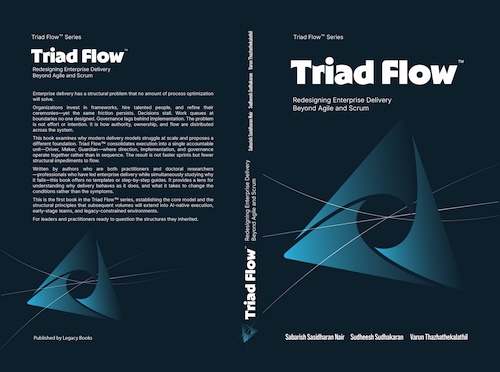
Triad Flow™ — Redesigning Enterprise Delivery Beyond Agile and Scrum

The foundational text. Establishes the core model in the enterprise context where it was forged: the Execution Triad of Driver, Maker, and Guardian, flow-based progression, minimal ceremony, and integrated governance. Examines why coordination costs exceed execution costs, why dependencies generate invisible work, and why dominant delivery methodologies are structurally mismatched to enterprise scale. Foreword by Raghav Setty, Managing Director at Charles Schwab.

Published by Legacy Books • 2025

Book 2

Triad Flow™ for AI-Native, Spec-Driven Execution

Extends Triad Flow™ into environments where AI capabilities are central to execution. Examines how specification practices change when implementation is cheap, how quality assurance adapts when iteration costs approach zero, and how governance structures evolve when the rate of change exceeds their designed capacity. Addresses the transformation of the Maker role — from owning the act of building to owning the judgment that guides building.

Pre-Order
Book 3

Triad Flow™ for Early-Stage and Startup Product Teams

Develops a variant of Triad Flow™ suited to early-stage organizations — small teams, undefined processes, and the need to establish rather than reform. The framework's minimalism suits small teams that cannot afford overhead, while its structural principles provide a foundation that scales. Addresses how roles may collapse when a five-person company cannot constitute multiple triads.

Coming 2026
Book 4

Triad Flow™ for Legacy and Enterprise Product Teams

Addresses execution under constraint. Examines how Triad Flow™ principles can be applied incrementally within boundaries set by external requirements — established processes that cannot be abandoned, regulatory requirements that dictate certain practices, organizational politics that resist structural change. Provides strategies for improvement within limits, not promises of transformation.

Coming 2026

Inside Book 1

Part I

The Problem Space

Three chapters establishing why enterprise delivery struggles: the coordination tax and dependency webs that emerge at scale, why Agile and Scrum fail at enterprise scale due to structural mismatch with their design assumptions, and why AI accelerates code but not organizations — exposing the gap between implementation speed and organizational speed.

Part II

Introducing Triad Flow™

The core model: why the execution model is the primary constraint, the five properties of a viable execution model, and the Execution Triad of Driver, Maker, and Guardian. Establishes consolidated ownership as the primary lever for restoring speed, and flow cycles that replace time-boxed sprints with readiness-governed progression.

Part III

Operating Triad Flow™

How the model works in practice: minimal ceremonies with maximum signal, governance without bureaucracy through integrated risk ownership, and measuring outcomes rather than activity. Introduces the Custodian function that protects the operating model from structural erosion.

Parts IV–V

Practical Application & Scaling

A detailed project narrative showing the model in action, followed by scaling principles: portfolio alignment without central planning, the Orchestrator and Steward of Flow functions, aggregation through shared outcomes, and the discipline of maintaining simplicity at scale. Concludes with execution as competitive advantage.

Academic Research

White paper & journal submissions

Peer-reviewed research underpinning the Triad Flow™ framework. The authors are doctoral researchers contributing to the academic body of knowledge on enterprise delivery, execution models, and organizational design.

Journal Submission — Under Review

Triad Flow™: Redesigning Enterprise Software Delivery Beyond Agile and Scrum

A Structural Analysis of Enterprise Delivery Constraints and a Consolidated Ownership Model for Flow-Based Execution

Sabarish Sasidharan Nair¹* Varun Thazhathekalathil² Sudheesh Sudhakaran³

¹ Senior Engineering Manager, Cox Automotive, Austin, TX, USA; Ph.D. Candidate (IT), MIT ADT University, Pune, India

² SAP Support Delivery Lead, Apple, Cupertino, CA, USA; DBA Candidate, California Southern University, Costa Mesa, CA, USA

³ AWS Solution Architect & AI Specialist, Baxter International, Chicago, IL, USA; Ph.D. Candidate (IT), MIT ADT University, Pune, India

*Corresponding Author: Sabarish Sasidharan Nair

Abstract

Enterprise software delivery at scale is structurally constrained by coordination costs that grow non-linearly with organizational complexity. This paper identifies five enterprise delivery constraints — coordination cost inversion, dependency proliferation, governance bottleneck, measurement misalignment, and AI amplification of structural deficits — and presents Triad Flow™, a consolidated ownership model designed to address them simultaneously. The model organizes execution around a three-domain structure (Driver, Maker, Guardian) that co-locates decision authority at the point of execution, replaces time-boxed iteration with readiness-governed flow cycles, and embeds governance as a continuous function rather than a sequential gate. We define the model’s five design properties, its execution mechanics including flow-based progression and integrated governance, and the structural roles (Custodian, Orchestrator, Steward of Flow) that protect simplicity at scale. A measurement framework aligned with flow outcomes rather than activity metrics is proposed. Scaling considerations address portfolio alignment, multi-triad coordination, and AI-native execution environments. The contribution is a structurally integrated execution model that consolidates the fragmented concerns of delivery, governance, and organizational coordination into a single operating framework.

Journal International Journal of Multidisciplinary Allied Research Review (IJMARR)
Status Under Review • Pre-Print
Keywords Enterprise software delivery; Agile at scale; execution operating model; Triad Flow; consolidated ownership; flow-based execution; governance integration; coordination costs
References 20 cited works including Reinertsen (2009), Forsgren et al. (2018), Dikert et al. (2016), Skelton & Pais (2019)
Download Pre-Print (PDF) Citation available upon publication

In Progress

Upcoming research

Draft

When Implementation Cost Approaches Zero: Structural Implications of AI-Native Execution for Enterprise Delivery Models

Examines how AI-driven code generation disrupts the assumption that implementation is the primary constraint in delivery. Proposes that when building becomes cheap, the organizational bottleneck shifts to specification quality, judgment velocity, and governance capacity — domains the Maker and Guardian roles must evolve to address.

Expected submission Q3 2025
Draft

Measuring the Coordination Tax: An Empirical Study of Enterprise Delivery Overhead in Distributed Engineering Organizations

Quantitative research measuring the ratio of coordination activity to execution activity across twelve enterprise engineering organizations. Tests the hypothesis that coordination cost exceeds execution cost at enterprise scale and examines structural predictors of the inversion.

Expected submission Q4 2025

Foreword

From the foreword